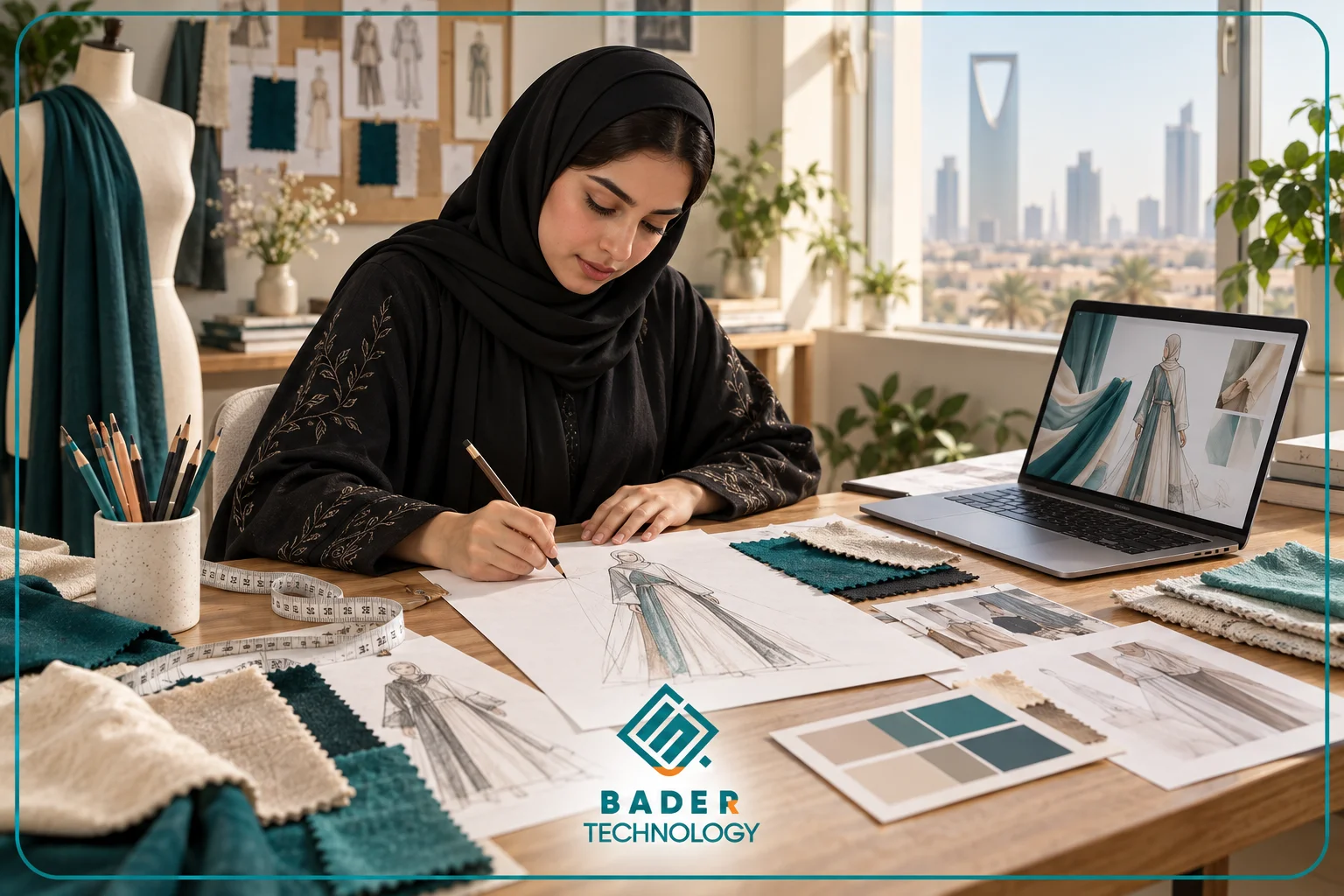
A fashion design course for beginners in Riyadh can help you turn your interest in fashion into clear, practical steps: understanding design elements, developing ideas, choosing colors and fabrics, creating a mood board, developing visual concepts, and presenting your work professionally. However, courses are not all the same. Some focus on fashion illustration, others on pattern making and sewing, while others focus on digital design and artificial intelligence. In this guide, you will learn about the differences between these paths, what you actually need to get started, and how to choose the right path for your goals.
How Do I Start Learning Fashion Design from Scratch?
Start by understanding the basic elements of fashion design, color, fabric, and garment shape. Then learn visual research and how to create a mood board, and turn your ideas into sketches or digital concepts. After that, develop a small, cohesive collection and learn the basics of pattern making and garment construction according to your goals. Finally, collect your best work into a portfolio.
Artificial intelligence can speed up concept generation and help you experiment with different alternatives, but it does not replace design knowledge or creative judgment.
What Is Fashion Design?
Fashion design is the process of developing a garment or collection that combines aesthetic ideas, functionality, and the needs of the target user. The process begins with research, inspiration, and understanding the target audience. It then moves into decisions about lines, colors, fabrics, silhouettes, and details before progressing to prototyping, production, and refinement.
A fashion designer's role is not limited to drawing a beautiful dress. Designers need to understand the relationship between body shape, fabric, movement, and use. They also need to understand how a garment looks from different angles and how it fits within a visual identity or a cohesive collection. This is why structured learning is often more useful than simply collecting unrelated sketches without a clear purpose or context.
Who Is Fashion Design Suitable For?
Fashion design can be suitable for:
- Beginners who want to explore the field before pursuing specialized education.
- People who are passionate about drawing, fashion, and developing visual ideas.
- Entrepreneurs who want to launch a fashion brand or small business.
- Professionals working in marketing, content creation, and fashion branding.
- Traditional fashion designers who want to add digital tools and artificial intelligence to their workflow.
What Is the Difference Between Fashion Design, Sewing, Pattern Making, and Styling?
Confusing these paths can lead you to choose a course that does not match your goals. Programs may have similar names, but they can teach very different skills and lead to different outcomes.
Fashion Design
The main focus is developing the concept, identity, silhouette, colors, fabrics, and details of a garment or collection. The expected outcome is a design or cohesive collection that can be further developed.
Fashion Illustration
The focus is visually presenting the concept on a fashion figure and showing fabrics, proportions, and details. The outcome is usually a set of hand-drawn or digital fashion illustrations.
Pattern Making
The focus is transforming a design into pieces and measurements that can be cut and constructed. The expected outcome is a practical pattern for the garment.
Sewing and Garment Construction
The focus is assembling fabric pieces, constructing the garment, and finishing it properly. The outcome is a completed clothing product.
Fashion Styling
The focus is selecting clothing and accessories and creating a complete look. The outcome is a coordinated appearance for an individual, photoshoot, campaign, or fashion brand.
Digital Design and Artificial Intelligence
The focus is generating concepts, experimenting with alternatives, and developing visual presentations. The outcome is faster visual concepts and prototypes that can be reviewed and refined.
If your goal is to make garments yourself, you will eventually need pattern making and sewing skills in addition to design. If your goal is to develop fashion concepts, collections, and digital visuals, look for a fashion design course that focuses on design thinking, visual identity, and presentation.
What Are the Most Important Fashion Design Basics for Beginners?
A good course should start with fundamental principles rather than immediately focusing on a particular tool or software. Fashion design basics for beginners include composition, color, fabric, visual research, concept development, and collection development.
Some of the most important skills include:
Design Elements and Garment Composition
These include line, shape, proportion, balance, rhythm, and focal points. Understanding these elements helps designers explain why a design works visually instead of relying only on personal impressions.
Color Theory and Building a Color Palette
Designers learn about color relationships, saturation, contrast, and how to create a palette that supports the concept, target audience, and season rather than simply choosing colors that look attractive individually.
Fabrics and Fabric Behavior
Fabric weight, texture, drape, and stretch affect the shape and movement of a garment. A visually attractive digital concept is not enough if the suggested fabric cannot support the silhouette or intended use.
Visual Research and Mood Boards
A mood board brings together images, colors, fabrics, and shapes that define the direction of a design. Its purpose is not simply to collect trendy images, but to unify design decisions and prevent the collection from becoming visually inconsistent.
Drawing and Visual Concept Development
Beginners learn how to communicate the shape, proportions, and details of a garment, either by hand or digitally. The goal is to communicate the idea clearly to an instructor, client, or production team rather than simply creating an independent piece of artwork.
Fashion Collection Development
A collection consists of garments connected by a shared concept and visual language. Designers learn how to create variety while maintaining consistency and how to determine whether each piece adds real value to the collection.
Presenting Your Work and Building a Portfolio
This includes selecting your strongest projects, organizing the journey from research to final result, and explaining your design decisions rather than showing only the finished images.
Do I Need to Be Good at Drawing Before Taking a Fashion Design Course?
No. You do not need to be a professional artist to start learning fashion design, but the ability to communicate ideas visually is important. Fashion illustration skills can be developed through practice with proportions, lines, and fabric representation. Templates, digital design programs, and AI tools can also be used during the early stages.
What matters most is not how beautiful the drawing is, but how clearly you communicate the design decision: the garment shape, concept, details, fabric, color, and relationship to the rest of the collection.
If you use a digital tool, you should still be able to evaluate and modify the result. An AI tool may generate an attractive image, but that does not necessarily mean the garment is practical to produce or suitable for the intended identity.
A Beginner's Fashion Design Learning Plan
You can use the following plan as a flexible starting point. The stages do not need to follow a fixed number of weeks because learning speed depends on the amount of time available, the type of project, and the quality of feedback you receive.
Explore the different paths: Understand the difference between fashion design, illustration, pattern making, sewing, styling, and digital design.
Learn the fundamentals: Study line, shape, proportion, balance, color, and fabric.
Build a visual library: Analyze different designs and record what makes their silhouettes, colors, and details distinctive without simply copying them.
Practice concept development: Sketch by hand or use digital tools to create multiple alternatives for your ideas.
Start with a small project: Design three to five garments around one concept instead of creating a large number of unrelated ideas.
Test practicality: Review the fabric, movement, sizing, and details with someone who has experience in garment construction.
Document the project: Include your research, mood board, experiments, revisions, and final results in an organized portfolio.
Simple Tools Beginners Need
Beginners can start with:
- A sketchbook, pencils, and coloring tools for quick experiments.
- Fabric images or physical fabric samples to understand texture and drape.
- A tool for organizing mood boards and visual references.
- A drawing or digital design program if you choose the digital design path.
- A suitable device and reliable internet connection when using AI tools.
How Can Artificial Intelligence Help in Fashion Design?
AI-powered fashion design has become part of the creative workflow for some designers and fashion brands. It can be used to expand the space for experimentation rather than replacing the designer or their technical knowledge.
Practical Uses for Beginners
AI can help with:
- Generating initial visual directions around a concept or story.
- Experimenting with different color palettes, fabrics, and silhouettes quickly.
- Developing more cohesive digital mood boards.
- Turning a written description or rough sketch into a visual concept for review.
- Exploring how a collection or campaign could be presented before production.
- Creating initial prototypes for presentation to a client or team, as long as they are clearly identified as concepts.
What Can AI Not Do on Its Own?
AI does not guarantee that a garment will be practical to produce. It does not automatically choose the right fabric, solve sizing and pattern-making problems, or guarantee manufacturing quality.
Designers should also review image and tool usage rights and avoid directly imitating the work of a specific designer or brand.
The designer remains responsible for the concept, selection, refinement, suitability, and originality of the final design.
The Role of the Designer Throughout the Process
Research: The designer determines the target audience, story, and identity, while AI can suggest initial directions and references for review.
Concept Development: The designer chooses the silhouette, details, and fabric, while AI can quickly generate visual alternatives.
Evaluation: The designer rejects unsuitable results and corrects problems, while AI makes it easier to compare different concepts.
Production: The designer tests the pattern, sizing, fabric, and quality, while AI provides an initial visual concept rather than replacing an actual sample.
How Do You Choose the Best Fashion Design Course in Riyadh?
The word "best" depends on your goal. Before paying the course fee, ask for clear answers to the following questions:
The course path: Does the course focus on fashion design, illustration, pattern making and sewing, or digital design?
Beginner level: Is it suitable for people with no previous experience? What knowledge is required?
Final project: Will you finish with a project that can be added to your portfolio?
Practical training: How much of the course involves exercises and feedback compared with theoretical explanation?
The instructor: Does the instructor have practical experience and a portfolio of work you can review?
Tools: Will you need a computer, subscriptions, or additional software?
Location and schedule: Check the training location in Riyadh, attendance schedule, and absence policy.
Certificate: Ask what type of completion certificate is provided and which organization issues it. Do not rely on the word "accredited" without checking the details.
Total cost: Consider the cost of software, tools, and fabrics if required, rather than looking only at the registration fee.
Is In-Person or Online Training Better?
In-person training is suitable for learners who need direct interaction, immediate feedback, and a structured schedule. Online training provides greater flexibility but requires discipline and a suitable working environment.
For programs that involve fabrics or hands-on garment construction, direct observation and practical supervision can be particularly useful. On the other hand, many aspects of digital fashion design can be learned online if the course provides clear practical assignments and adequate support.
How Do You Build Your First Fashion Design Portfolio?
A portfolio does not need dozens of projects. Two or three well-documented projects are better than many images without context.
For each project, include:
- A short title and an explanation of the idea or problem the design addresses.
- A description of the target audience, occasion, or intended use.
- A mood board, color palette, and suggested fabrics.
- Experiments and alternatives, including concepts that were later modified.
- Final designs, garment details, and their relationship to each other.
- The tools you used, including AI if it was involved.
- A short note about what you learned and what you would improve in the next version.
Avoid presenting AI-generated images as finished products if they are only concepts. Transparency demonstrates your actual ability to direct the tool, evaluate the results, and develop the design.
Fashion Design Course with AI at Bader Academy
Bader Academy in Riyadh offers an in-person program that combines fashion design fundamentals with digital tools and artificial intelligence. According to the current course page, the program lasts 35 training hours over five days, and the advertised price at the time this guide was updated is SAR 2,999.
Prices and schedules may change, so check the program page before registering.
Key Topics Covered in the Program
The program covers topics such as:
- Introduction to fashion design and artificial intelligence.
- Design principles, color coordination, fabrics, and silhouettes.
- Writing prompts and creative descriptions and generating multiple concepts.
- Creating mood boards and developing visual identity.
- Creating initial models and visual concepts and improving the outputs.
- Trend analysis and developing an initial fashion collection.
- Completing a practical project and building an initial portfolio.
Is the Course Suitable for Beginners?
The program page indicates that advanced fashion design experience is not required and that basic background knowledge can be an advantage.
Participants need basic computer and internet skills, a suitable device, and a willingness to complete practical assignments.
If your primary goal is to learn sewing or advanced pattern making, ask the academy about the depth of these topics because the published curriculum focuses mainly on design, digital visualization, and artificial intelligence.
Do You Want to Develop Your First Digital Fashion Project?
Review the program page to check the upcoming cohort date, training location, current requirements, and current price. Then compare the curriculum with your personal goals before registering.
Explore the Fashion Design Course with Artificial Intelligence
Bader Academy's listed address is 7795 King Abdulaziz Road, Third Floor, Office 22, Al Yasmin District, Riyadh. Check the location of your specific cohort before attending through the academy's contact page.
You can also explore the academy's other training courses or learn about graphic design basics for beginners if you have a broader interest in visual design.
What Can You Do After Learning Fashion Design?
A course does not guarantee a job by itself, but it can help you explore the field, build initial work, and identify the skills you need to develop further.
Potential paths related to fashion design include:
- Developing initial ideas and collections for a fashion brand.
- Assisting a designer or creative team with research and visual concept development.
- Providing digital design and visual presentation services for startups.
- Creating visual content and initial campaigns for fashion brands.
- Moving into more advanced studies in pattern making, sewing, or digital fashion design.
- Starting a small personal fashion project after testing the concept, costs, production process, and market.
Professional success requires continuous practice, a clear portfolio, an understanding of production and the market, and the ability to receive feedback and improve your designs—not simply a completion certificate.
Choose the Path That Matches the Result You Want
Looking for a fashion design course for beginners in Riyadh is a good starting point, but the right choice depends on what you want to produce after completing the course.
If your goal is to make garments yourself, choose a path that combines fashion design with pattern making and sewing. If your goal is to develop concepts, digital visuals, and an initial fashion collection, a fashion design path supported by artificial intelligence may be more suitable.
Compare the curriculum, final project, requirements, and practical training before making your decision. Then start with a small collection and build an honest portfolio that shows your thinking and development.
You can also review the details of the AI-powered fashion design course at Bader Academy before registering.
Is a Fashion Design Course Suitable for Complete Beginners?
Yes, if it starts with the fundamentals and does not assume any prior knowledge. Review the course topics, requirements, and final project, and make sure you understand whether the focus is on fashion design, sewing, pattern making, or digital tools.
Is Fashion Design the Same as Sewing?
No. Fashion design focuses on developing the concept, silhouette, colors, fabrics, and visual identity, while sewing is used to construct the garment, and pattern making transforms the design into patterns and measurements that can be cut and assembled.
Can I Learn Fashion Design with Artificial Intelligence Without Prior Experience?
Beginners can use AI tools, but the results improve when you understand color, fabric, silhouettes, and composition. Bader Academy's course starts with the fundamentals listed in its program while also introducing digital tools, and it does not require advanced experience according to the program page.
Can Artificial Intelligence Replace Learning Drawing and Pattern Making?
No. AI can help generate visual concepts and experiment with different alternatives, but it does not guarantee practicality, proper sizing, or appropriate fabric behavior. How much drawing and pattern-making knowledge you need depends on your role and the outcome you want to create.